Get in touch: +1 888 904 4161



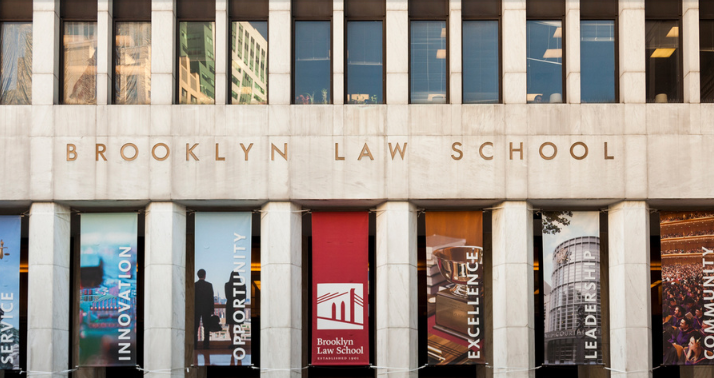
A 44% acceptance rate makes Brooklyn Law look more accessible than the T14 schools most applicants are also applying to. Sure, your odds of getting in are significantly better than at a school accepting only 6% of applicants. But nearly half the people who applied last cycle still didn't get in, and the applicants who treat Brooklyn Law School as a backup they don't need to research are the ones who usually don’t get in.
Many students apply to Brooklyn Law with a 163 LSAT and generic optional essays they recycled from their Columbia application. They assumed the numbers would automatically carry them to a school with a higher acceptance rate, but they were wrong.
The guide below covers what scores you need, what Brooklyn Law's admissions committee actually prioritizes, and how to build an application that proves you chose this school deliberately instead of just using it as a backup option.
If you’re just here for the requirements, click here.
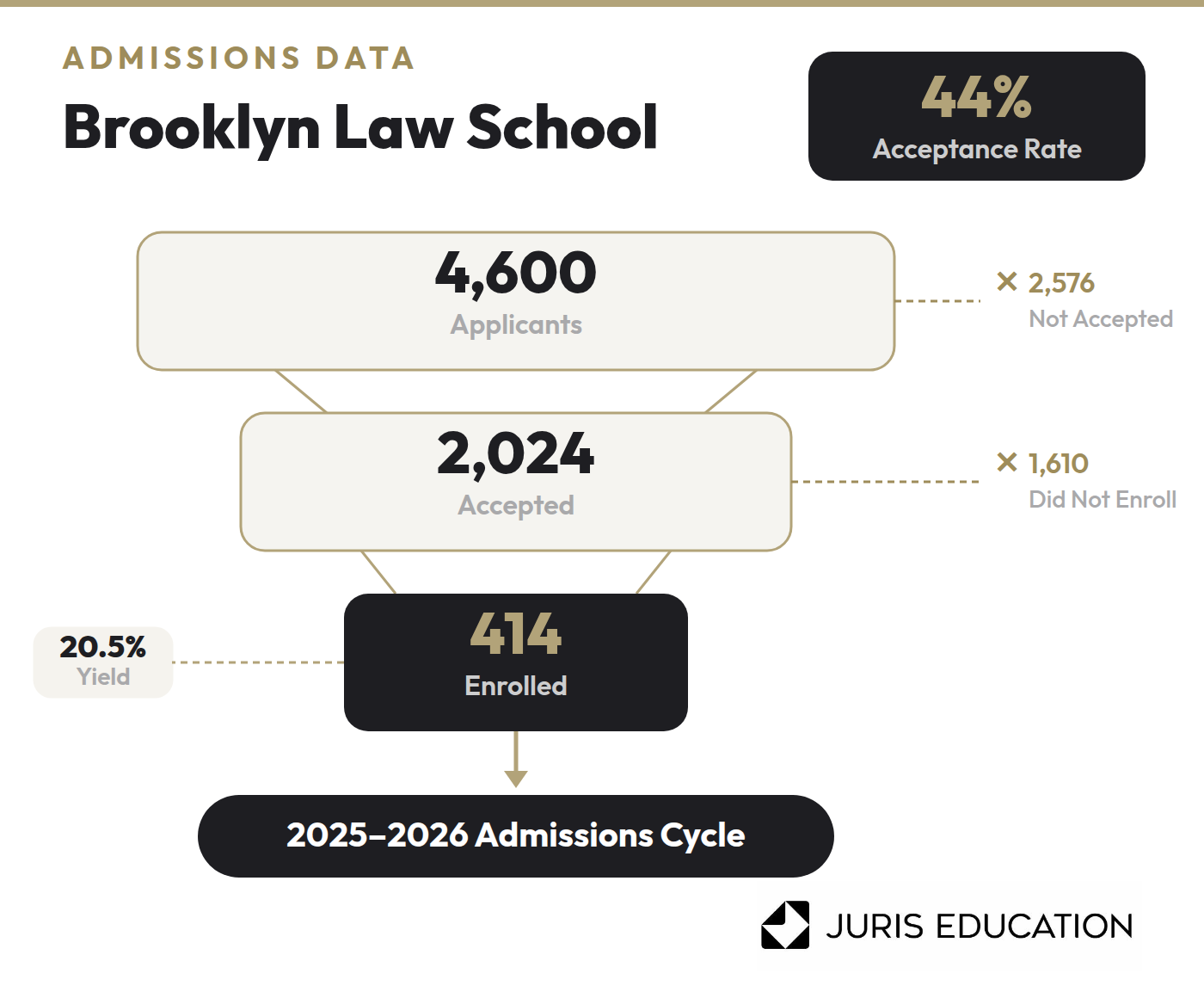
In the 2025-2026 admissions cycle, Brooklyn Law School had an acceptance rate of 44.00%, according to data from the American Bar Association (ABA). In this admissions cycle, Brooklyn Law School received 4,600 applicants, offered acceptance to 2,024, and enrolled 414 students.
The graphic below shows how Brooklyn Law School’s acceptance rate has changed over the past five admissions cycles:
It’s challenging to get into Brooklyn Law School. In the 2025-2026 admissions cycle, just under half of all applicants were offered a seat. On average, in the past five admissions cycles, Brooklyn Law School has had a 46.83% acceptance rate. That means typically, 1 in 2 students gets accepted to Brooklyn Law School.
However, even with those odds, you still need a standout application to be considered. All of your application components should connect to why you want to study law, why you want to study law right now, and why you want to study law specifically at Brooklyn Law School.
In the 2025-2026 admissions cycle, Brooklyn Law School matriculants had a median LSAT score of 161. The school doesn’t have a minimum LSAT score required for admission, so you can apply with any score.
Take a look at the graphic below and enter your LSAT score to get a sense of how competitive it is at Brooklyn Law School:
According to the Law School Admissions Council (LSAC), the national median LSAT score among all law school applicants was 159 in the 2025-2026 admissions cycle. That means most students at Brooklyn Law School score 1.25% higher on the LSAT than law school applicants on average.
The median GPA of Brooklyn Law School matriculants in the 2025-2026 admissions cycle was 3.59. You don’t need a minimum score to be considered for admission.
The tool below shows the GPA percentiles of previous matriculants at Brooklyn Law School. Enter your GPA to see how competitive it is relative to other matriculants:
According to the LSAC, in the 2025-2026 admissions cycle, the national median GPA among all law school applicants was 3.68. That means most students at Brooklyn Law School have a GPA 2.51% lower than the national median.
Only nine matriculants in the 2025-2026 admissions cycle submitted the GRE when applying to Brooklyn Law School, so there isn’t enough data to support percentile scores. Compared to the 405 matriculants who submitted the LSAT, submitting the GRE is much less common for clearing the initial screening phase. Only submit the GRE if you have an exceptional score or if it’s much better than your LSAT score.
Write your personal statement to demonstrate at least two of the six specific qualities Brooklyn Law School names on its admissions page:
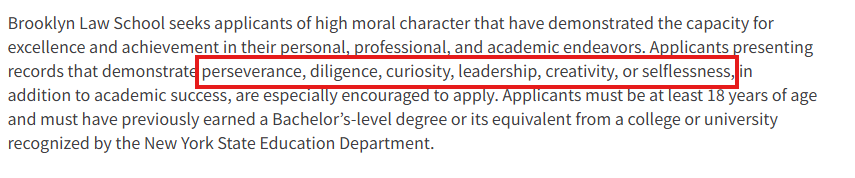
You don’t have to write anything specific about Brooklyn Law School in your personal statement, as this will limit your options at other schools. However, you can and should write a story that can apply to any law school that highlights two of those qualities.
The admissions committee evaluates each applicant's "character and fitness, commitment to a legal education, academic achievement, aptitude for successful law study, life experience, and other key indications of professional promise." That phrase "professional promise" connects directly back to those six traits.

Write a personal statement that shows perseverance through a specific time of difficulty in your life or career. Pair it with curiosity by showing how that experience got you to ask questions that you continued to pursue.
An applicant who spent two years working in community health could demonstrate diligence through the role's daily expectations and selflessness through the populations served. The key is to name the behavior and show it in action rather than labeling yourself with the adjective.
Watch the video below to learn how to write the perfect personal statement:
Brooklyn Law School accepts optional essay submissions alongside the required personal statement. Write one to connect your professional interests to a specific Brooklyn Law School program.
The Center for Urban Business Entrepreneurship (CUBE) is Brooklyn Law School's most popular legal offering. It sits within the Brooklyn Tech Triangle and runs clinics such as the Brooklyn Law Incubator and Policy Clinic (BLIP), where students advise startups and emerging companies.

If you have a background in business, tech, or entrepreneurship, the optional essay is where you connect it to law school. But connecting your goals to CUBE isn’t the only angle you can take.
Brooklyn Law School runs one of the country's oldest clinical programs, with hybrid externships at the Brooklyn DA's office, a Veterans' Rights Clinic, an LGBTQ Advocacy Clinic, and the BLS/EXI Innocence Project. An applicant interested in criminal defense could explain why working at the NYS Supreme Court and the U.S. Courthouse for the Eastern District matters to their learning goals.
Save your personal statement for "why law." Make the optional essay about "why Brooklyn Law."
Brooklyn Law School requires every student to complete at least one clinical placement or externship before graduating. Brooklyn Law School repeatedly describes its clinical program as one where students take on "real clients" facing "real legal challenges" and represent them in "real cases."
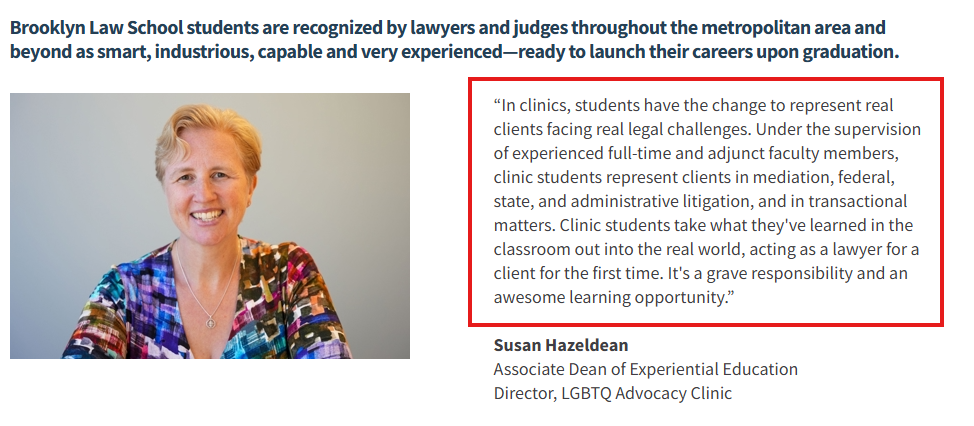
The admissions committee reads for evidence that you can handle that responsibility. Your resume and personal statement should include experiences in which you worked directly with individuals in need.
Client-facing roles in legal aid offices count. So do crisis hotlines, tenant advocacy organizations, immigration assistance programs, and social work placements. Even customer-facing business roles demonstrate comfort with interpersonal relationships.
An applicant who volunteered at a mediation center for two years demonstrates readiness to engage with Brooklyn Law School’s Mediation Clinic. Someone who worked at a veterans' services nonprofit speaks directly to the Veterans' Rights Clinic.
Brooklyn Law School rewards a pattern of showing up for people, not just learning about them.
If Brooklyn Law School is your top choice, apply through the binding Academic Excellence Early Decision Program by December 1. You need a much more competitive LSAT score and GPA when you apply to this program, as it’s designed for extremely competitive candidates, hence the name “Academic Excellence”.
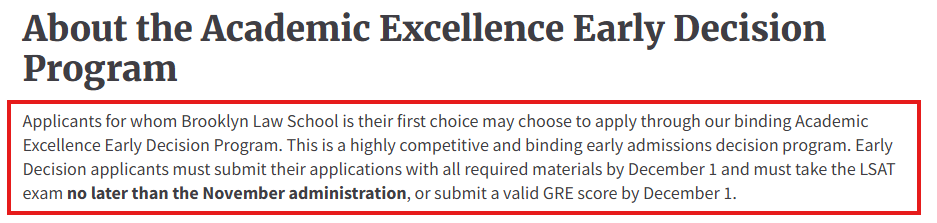
You need to complete your LSAT by the November administration or submit a valid GRE score by December 1. Brooklyn Law School uses rolling admissions and reviews applications as they’re completed. Applications completed by February 1 receive first consideration in the regular pool, but Early Decision applicants get reviewed even earlier with a smaller competitive field.
However, if you’re admitted, you have to commit to the binding agreement. For applicants whose numbers are already above Brooklyn Law School's medians (161 LSAT, 3.59 GPA based on recent class data), Early Decision removes months of uncertainty and positions you for the strongest scholarship consideration at the front of the cycle.
Even though it’s optional, write the diversity statement when applying to Brooklyn Law School. The school’s institutional identity is inseparable from its founding commitment to inclusion.
The school opened in 1901 during an era when many law schools excluded women and racial and religious minorities, and Brooklyn Law School admitted all qualified applicants regardless of their background.
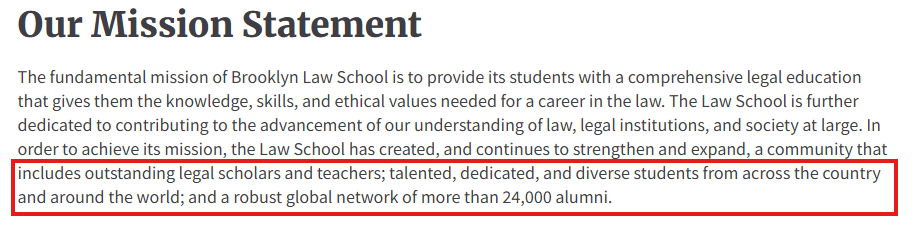
The mission statement page confirms that Brooklyn Law School evaluates "diverse students from across the country and around the world."
Your diversity statement doesn’t need to focus on your race or ethnicity, because Brooklyn Law School defines diversity broadly. Write about the perspective you formed from your specific combination of geography, socioeconomic background, professional experience, or personal circumstances.
An applicant who grew up in a rural farming community and then worked in Manhattan finance brings a perspective contrast that Brooklyn Law School values. Someone who navigated the legal system as a first-generation immigrant can speak to why access to legal education matters.
The diversity statement is your chance to show the admissions committee that you’ll contribute to the kind of learning environment they’ve spent over a century building.
For more ideas on building your own unique application narrative, watch the video below:
Experts at Juris Education can provide you with law school admissions support. Our admissions coaches will work with you to build a compelling application that will help you get into Brooklyn Law School.
A competitive candidate at Brooklyn Law School pairs a 163+ LSAT with a 3.75+ GPA and brings hands-on experience working directly with people or communities. Brooklyn Law School says it values more than academics, so you need standout qualities beyond academics to differentiate your application.
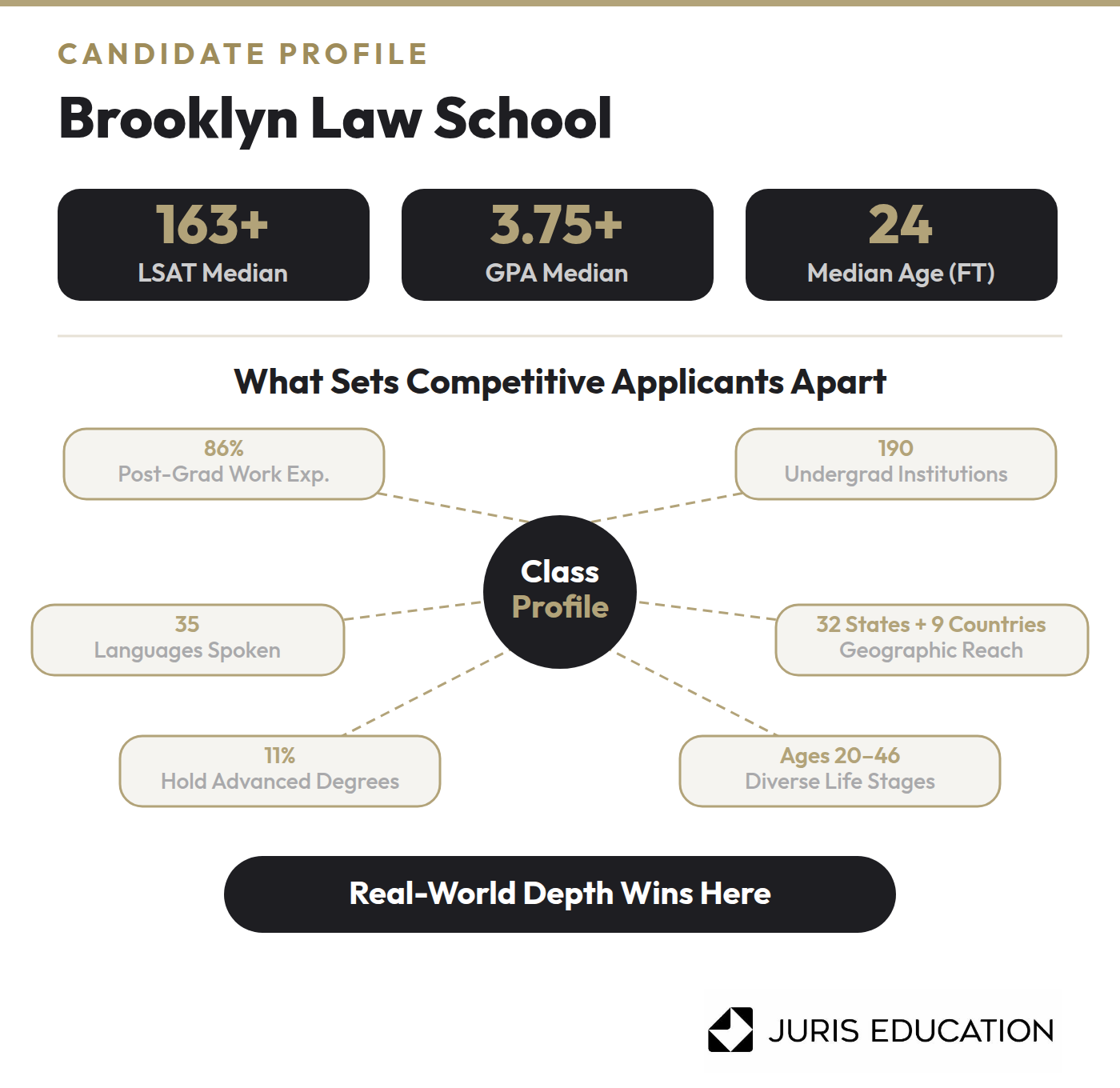
According to the school's entering class profile:
This suggests that the admissions committee values professional depth, lived experience, and the kind of perspective that comes from working in the real world before stepping into a courtroom. The most recent class profile demographics included:
Your strongest application will pair competitive academics with client-facing or community-centered experience, and include a personal statement that demonstrates at least two of the six character traits Brooklyn Law School lists on its admissions page.
Submit all materials through the LSAC and its Credential Assembly Service (CAS). Brooklyn Law School reviews applications on a rolling basis and will not begin reviewing yours until it receives all required components:
Applications open September 1. The Academic Excellence Early Decision deadline is December 1 (binding), and applications completed by February 1 receive first consideration in the regular pool. There is no regular decision deadline, but the rolling admissions process favors earlier applicants.
Take a look at the video below for a complete last-minute law school application checklist:
Brooklyn Law School's first-time bar passage rate is 85.47% for the class of 2025, based on the most recent ABA bar passage data. In New York, where most Brooklyn Law School graduates sit for the bar, 290 of 338 first-time takers passed in 2025 for an 85.80% pass rate, just 1.47% below the statewide average for Council-accredited law schools.
No, Brooklyn Law School doesn’t conduct interviews as part of the standard admissions process. The volume of applications prevents the school from scheduling them for every candidate. Prospective students can visit campus and interact with current students and admissions staff, but those conversations are informational only and don’t factor into the admissions decision.
Brooklyn Law School offers a standard three-year JD program, an extended four-year part-time JD program, and an LLM program for internationally trained lawyers. The school also runs joint degree programs with other New York City institutions, including a JD/MBA with Baruch College, a JD/MS in City and Regional Planning, and a JD/MUP in Urban Planning. For students interested in international law, Brooklyn Law School offers JD/LLM dual degrees with seven partner schools in Germany, Spain, France, Ireland, and the Netherlands that can be completed in three years.
David Merson was the original author of this article. Snippets of his work may remain.
Co-Founder of Juris Education, Dartmouth College


.svg)
